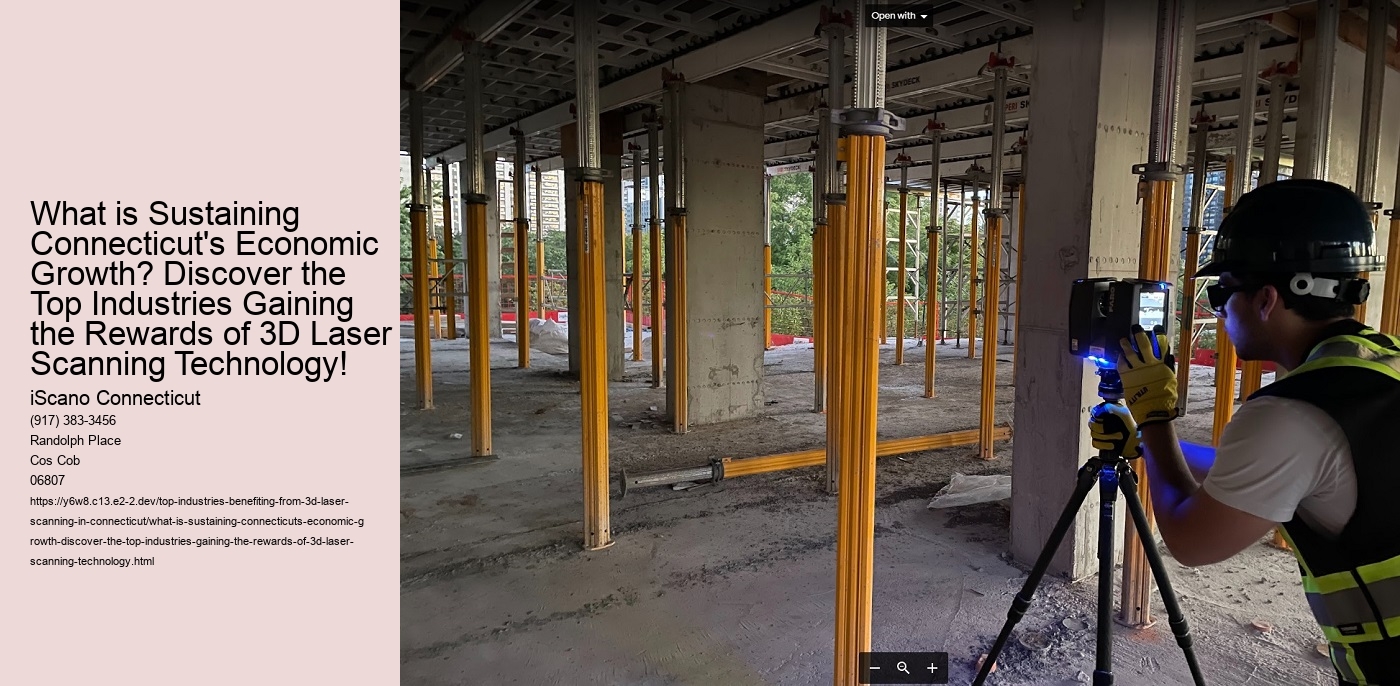
As Connecticut continues to browse the waves of economic advancement, it's coming to be progressively clear that modern technology plays a critical duty in maintaining growth and competition. What is Fueling Connecticut's Economic Growth? Discover the Top Industries Gaining the Benefits of 3D Laser Scanning Technology! . Amongst the various technological advancements, 3D laser scanning technology has actually emerged as a transformative force across several markets within the state. This essay provides a summary of 3D laser scanning technology and highlights the leading markets in Connecticut gaining its advantages.
3D laser scanning, additionally known as LiDAR (Light Detection and Ranging), is a non-contact, non-destructive innovation that digitally captures the shape of physical things making use of a line of laser light. This innovation produces "" point clouds"" of information from the surface of a things. In essence, 3D laser scanners determine great information and capture free-form shapes to swiftly produce very accurate point clouds. It is extensively pertained to for its precision, rate, and convenience.
In Connecticut, the aerospace sector stands as a primary beneficiary of 3D laser scanning technology. The state is home to a significant number of aerospace suppliers that count on the extreme accuracy of 3D laser scanning to develop parts that satisfy extensive security and top quality standards. The technology allows rapid prototyping, quality control, and the ability to reverse-engineer parts with complicated geometries, therefore lowering time-to-market for brand-new developments.
The construction and style industries also substantially take advantage of 3D laser scanning. In a state with an abundant tapestry of historic buildings and modern facilities, preserving and restoring frameworks calls for thorough preparation and implementation. 3D laser scanning offers engineers and designers with comprehensive versions of existing frameworks, allowing for precise repairs and guaranteeing brand-new enhancements mix flawlessly with the old. In addition, it facilitates the tracking of building and construction jobs, making sure that they remain on track and within budget plan.
Another industry profiting is producing. Connecticut's manufacturing industry, which includes medical gadget production, auto, and commercial machinery, makes use of 3D laser scanning to enhance their layout processes, enhance quality assurance, and improve their supply chains. The technology's ability to promptly capture and assess complicated sizes and shapes permits much better quality control and a much more effective production procedure.
Marine sector in Connecticut likewise makes use of 3D laser scanning to design and manufacture boats and ship elements, ensuring precision and safety and security in a market where there is little margin for error. This innovation is specifically useful for retrofitting ships, as it can accurately catch the complicated shapes and tight rooms of a ship's interior, which are often difficult to determine with standard methods.
In ecological management and planning
The Aerospace Sector: Accuracy and Effectiveness with 3D Scanning
Connecticut's economic landscape is a lively tapestry of innovation and industriousness, with the aerospace sector rising as a substantial player. Amongst the technical wonders pushing this industry to brand-new elevations is the introduction of 3D laser scanning technology, a tool that personifies the future of accuracy design and production.
In the heart of the Constitution State, aerospace companies are not simply manufacturing components; they are crafting work of arts of engineering that should follow the most strict standards of quality and accuracy. The risks are high, as also the smallest inconsistency can jeopardize the safety and functionality of an airplane. This is where 3D laser scanning technology ends up being indispensable.
3D scanning has changed exactly how aerospace firms come close to the layout, prototyping, and manufacturing processes. With the ability to catch the geometry of things with awesome accuracy, engineers can produce digital reproductions of elements, assemblies, and even entire aircraft with a degree of detail that was previously unattainable. These digital models are then made use of for a myriad of objectives, from reverse engineering legacy parts to carrying out finite element analyses and aerodynamic simulations.
The benefits of 3D scanning in aerospace reach quality control as well. Checking the components generated, contrasting them against the original CAD styles, or inspecting the fit of put together areas can be completed with speed and precision that hands-on methods can not match. This not just guarantees that every piece satisfies the sector's rigorous criteria yet also significantly minimizes the moment and expense associated with the trial-and-error of prototype advancement.
In addition, the innovation has a lasting side. By maximizing styles for material efficiency and facilitating the repair service and repair of parts instead of substitute, 3D scanning sustains a more sustainable production cycle. This aligns with a growing consciousness in the direction of environmental obligation in the aerospace market.
The ripple effects of these developments in 3D scanning technology expand beyond the aerospace sector, affecting other top industries in Connecticut. From medical tool production, where accuracy can impact individual outcomes, to the marine industry, where hull designs take advantage of the in-depth scans to improve performance and safety and security, 3D laser scanning is a linchpin in the state's financial growth.
In conclusion, 3D laser scanning technology is a foundation of technology within Connecticut's aerospace sector, driving financial growth with its assurance of precision, efficiency, and sustainability. As the state continues to accept and incorporate these innovative innovations, it stands positioned to maintain its online reputation as a center of industrial expertise and economic
In the advancing landscape of Connecticut's economic situation, the integration of 3D laser scanning technology is having a transformative influence on multiple sectors, working as a driver for sustained economic advancement. This modern modern technology captures thorough three-dimensional details regarding physical items, settings, and intricate geometries in a portion of the time it takes with conventional methods, making it possible for precision and performance that were once unimaginable.
The building and construction and design industries go to the center of this technical transformation. 3D laser scanning improves style and structure processes by providing exact measurements and producing thorough digital models. It properly minimizes the moment invested in manual surveys and decreases human mistake, which converts to considerable cost savings and accelerated task timelines. In Connecticut, where city renewal and facilities growth are continuous, the capability to swiftly and precisely evaluate existing conditions is invaluable. For example, in the improvement of historic structures, laser scanning maintains architectural honesty while giving a clear pathway for innovation.
Aside from building and construction and style, various other industries in Connecticut are likewise profiting of 3D laser scanning technology. The production industry, particularly aerospace and protection, employs laser scanning for quality control, reverse engineering, and the rapid prototyping of complicated components. By ensuring elements are constructed to exact requirements, Connecticut's suppliers can keep a competitive edge in the international market.
The energy sector, including nuclear and renewable energy industries, makes use of 3D laser scanning for facility maintenance, retrofitting, and upgrading aging framework. This technology improves safety by allowing remote assessment of harmful areas and makes sure regulatory conformity by offering extensive paperwork for audits.
In addition, the heritage and historical fields take advantage of laser scanning to record and maintain Connecticut's rich archaeological sites. This non-invasive approach allows for the electronic conservation of artefacts and landmarks, guaranteeing that they can be examined and appreciated for generations to come.
In the realm of public safety and forensics, 3D laser scanning is an effective tool for criminal activity scene examination and accident reconstruction. By producing precise designs of criminal activity scenes, law enforcement can examine events more thoroughly and present engaging aesthetic proof in court procedures.
Generally, the assimilation of 3D laser scanning technology is a testament to Connecticut's dedication to advancement and financial development. By accepting these improvements, the state is not just improving the efficiency and precision of its markets but is also making sure that it continues to be at the cutting edge of technical advancement. As industries continue to harness the power of 3D laser scanning, Connecticut is positioned to experience a new period of success, noted by improved performance and sustainability
Connecticut's economic growth is a complex journey, driven by technology, efficiency, and the ruthless quest of high quality. At the heart of this trip is the manufacturing sector, a crucial gear in the state's economic engine that has been gaining the transformative benefits of 3D laser scanning technology. This essay discovers just how this cutting-edge technology is boosting product development and quality control, thereby maintaining Connecticut's economic development.
3D laser scanning technology has become a game-changer for Connecticut's producers. By enabling exact dimension and inspection of parts and assemblies, it has actually unlocked new levels of accuracy and detail that were previously unattainable. This modern technology catches the shape of physical objects utilizing a line of laser light, producing electronic 3D depictions that can be used for a myriad of applications, from reverse engineering to quality assurance.
In the world of product development, 3D laser scanning increases the style process, enabling designers to quickly model and refine their ideas. For Connecticut's aerospace and shipbuilding markets, this indicates that facility elements can be made and evaluated with unmatched rate and accuracy. As the state is home to leading makers like Pratt & & Whitney and Electric Watercraft, the capacity to rapidly iterate and excellent designs is not simply an issue of efficiency, yet also of maintaining a competitive edge in worldwide markets.
Furthermore, 3D laser scanning enhances quality control processes by providing thorough data on made elements. This permits very early detection of inconsistencies and stops expensive production errors. As a result, Connecticut's suppliers can ensure that the items they deliver satisfy the strictest quality requirements, a need for sectors where safety is extremely important, such as medical devices and protection.
Beyond improving individual services, the fostering of 3D laser scanning technology has wider financial effects. It promotes a society of innovation that brings in talent and financial investment, developing a virtuous cycle of development and growth. As more companies embrace this modern technology, the neighborhood supply chain comes to be a lot more robust, and the labor force more proficient, additional strengthening Connecticut's reputation as a hub of producing excellence.
Furthermore, the ecological influence of production is alleviated with making use of 3D laser scanning. Enhanced accuracy and reduced product waste contribute to more sustainable production methods, straightening with the state's goals of environmental stewardship and responsible financial growth.
In conclusion, 3D laser scanning technology is a foundation of modern manufacturing, providing Connecticut's industries with the tools they need to prosper in an affordable global economic situation. By improving product development and quality control, this
In the enchanting New England state of Connecticut, where background whispers from every colonial village and factory community, the blend of historical preservation and archaeology with contemporary technology is not just an academic workout-- it's a vital element of the state's financial development. At the center of this crossway is using 3D laser scanning technology, a tool that is reshaping the method Connecticut shields its past while safeguarding its future.
Visualize going through the rock streets of Mystic Port, where the maritime heritage of Connecticut revives. Currently, picture a group of experts furnished with 3D laser scanners meticulously recording every detail of the historic vessels and buildings. This cutting-edge technology enables the development of precise electronic replicas, maintaining the elaborate workmanship of lost ages for posterity. These electronic archives function as crucial references for repair projects, ensuring that any type of repair services or restorations preserve the credibility of the original structures.
Past conservation, 3D laser scanning has become a foundation in Connecticut's archaeology efforts. Archaeologists, once reliant on painstaking hand-operated dimensions, currently use this technology to swiftly and properly record excavation websites. The precision and rate of 3D scanning not only boost the cataloging of artefacts yet additionally reduce the disturbance to the websites, which is particularly crucial in locations of cultural significance. Through the development of online site versions, scientists worldwide can check out Connecticut's archaeological treasures without ever entering the state, expanding the reach of its historical narrative.
The economic effects of these applications are profound. As Connecticut's historical sites draw travelers from across the globe, the enhanced preservation and discussion of these destinations directly equate right into increased site visitor spending, boosting neighborhood organizations and maintaining work in the hospitality and service markets. Moreover, the data collected via 3D scanning can be repurposed for academic products, interactive displays, and also virtual reality experiences, opening new revenue streams in the modern technology and creative markets.
Furthermore, 3D laser scanning technology is not confined to the worlds of history and archaeology. Connecticut's manufacturing sector, particularly aerospace and defense, profits of this accuracy device for quality control, reverse engineering, and product development. The convenience of 3D laser scanning sustains the state's online reputation as a hub for technology and production quality.
As Connecticut remains to accept the capacity of 3D laser scanning, the effects for financial advancement are significant. By protecting the past with such modern-day ways, the state not just honors its abundant heritage yet additionally fosters a forward
In the wake of a rapidly progressing technological landscape, the importance of straightening education and learning and labor force training with the needs of a tech-driven economic climate can not be overemphasized. Connecticut, a state understood for its abundant background of innovation and production, stands at the cusp of a new era in economic advancement, stimulated by the introduction of 3D laser scanning technology. This technology is not simply a device; it is a gateway to a future where precision, effectiveness, and innovation are the characteristics of leading industries.
At the heart of this improvement is the requirement for a workforce that is not just tech-savvy but additionally adept at leveraging the abilities of advanced innovations such as 3D laser scanning. Education systems from K-12 to college organizations are hence tasked with a crucial duty: to prepare students for a workforce that requires a brand-new sort of literacy in electronic devices and data analysis.
3D laser scanning, which develops digital replicas of physical items and settings through using laser light, is reinventing sectors across the board. In Connecticut, industries such as aerospace, shipbuilding, architecture, and building and construction are profiting of this technology. By incorporating 3D laser scanning into their process, companies can dramatically improve precision and lower the moment needed for procedures like prototyping, quality control, and reverse engineering.
As an example, in aerospace, where precision is critical, 3D laser scanning makes sure that components and assemblies satisfy strict specifications. Shipbuilding take advantage of the technology by simplifying the retrofitting and repair service of maritime vessels. In style, laser scanning help in the exact documents and remodeling of structures, while in building and construction, it improves the planning process and tracking of development on job sites.
To sustain Connecticut's financial development in these leading markets, there is a burgeoning demand for professionals that excel in 3D laser scanning technology. Curriculum created around this demand are becoming a top priority. Area universities and technical institutions are creating specialized educational programs that offer hands-on experience with 3D laser scanning tools. Colleges are including the innovation right into engineering and style programs, ensuring that graduates are industry-ready.
Furthermore, workforce training efforts are essential in upskilling existing staff members to connect the tech gap. Partnerships in between market and schools are facilitating the creation of certification programs and proceeding education and learning programs customized to the details of 3D laser scanning applications.
Finally, as Connecticut remains to harness the power of 3D laser scanning technology for financial advancement, the synergy between education and labor force training ends up being
In the realm of technological development, 3D laser scanning has actually become a transformative force throughout numerous markets, contributing significantly to Connecticut's economic advancement. As we seek to the future, the possible development of this technology in the state is considerable, however not without its challenges.
Connecticut's financial landscape is diverse, with sectors varying from aerospace and protection to insurance coverage and finance. However, some sectors have been especially adept at leveraging the benefits of 3D laser scanning.
Aerospace and defense, for example, have used 3D laser scanning for accuracy manufacturing and quality control, making certain that elements fulfill rigid specs. This modern technology has actually been essential in decreasing manufacturing errors and improving safety, which are critical in this sector. As aerospace companies continue to introduce, the demand for a lot more exact and faster scanning services is most likely to stimulate growth in the 3D laser scanning market.
Similarly, the construction and style industries in Connecticut have actually seen substantial take advantage of incorporating 3D laser scanning into their workflows. With its ability to promptly and accurately record the measurements of complex structures, 3D scanning has actually revolutionized the means structures are designed, constructed, and kept. This effectiveness gain not just causes set you back savings but also improves the possibility for sustainable growth methods by decreasing waste and maximizing source usage.
The historical preservation industry likewise stands to take advantage of the development of 3D laser scanning. Connecticut, with its abundant heritage and various historic sites, can use this innovation to diligently record and maintain its historical structures. High-resolution scans provide a detailed document that can be used for remediation and instructional functions, making certain that the state's background is protected for future generations.
Nevertheless, the future outlook for 3D laser scanning in Connecticut is not without challenges. Among the primary obstacles is the price of the modern technology. Although prices have actually been lowering, the preliminary investment for high-grade 3D scanners can still be expensive for little to medium-sized business. To sustain financial advancement, it is essential for neighborhood companies to have accessibility to budget-friendly scanning services, which might necessitate support from state initiatives or public-private partnerships.
An additional challenge hinges on the accessibility of knowledgeable employees. The advanced nature of 3D laser scanning needs a labor force that is not only technically efficient yet additionally with the ability of interpreting and making use of the data properly. Financial investment in education and learning and training programs is essential in constructing a skill pool that can drive the modern technology's fostering and technology.
Additionally, concerns associated with data management, such as storage space, protection, and privacy, should be
History
For the first time in 1800, Connecticut shipwrights launched more than 100 vessels in a single year. Over the following decade to the doorstep of renewed hostilities with Britain that sparked the War of 1812, Connecticut boatyards constructed close to 1,000 vessels, the most productive stretch of any decade in the 19th century.[41]
During the war, the British launched raids in Stonington and Essex and blockaded vessels in the Thames River. Derby native Isaac Hull became Connecticut's best-known naval figure to win renown during the conflict, as captain of the USS Constitution.
The British blockade during the War of 1812 hurt exports and bolstered the influence of Federalists who opposed the war.[58] The cessation of imports from Britain stimulated the construction of factories to manufacture textiles and machinery. Connecticut came to be recognized as a major center for manufacturing, due in part to the inventions of Eli Whitney and other early innovators of the Industrial Revolution.[59]
The war led to the development of fast clippers that helped extend the reach of New England merchants to the Pacific and Indian oceans. The first half of the 19th century saw as well a rapid rise in whaling, with New London emerging as one of the New England industry's three biggest home ports after Nantucket and New Bedford.[60]
The state was known for its political conservatism, typified by its Federalist party and the Yale College of Timothy Dwight. The foremost intellectuals were Dwight and Noah Webster,[61] who compiled his great dictionary in New Haven. Religious tensions polarized the state, as the Congregational Church struggled to maintain traditional viewpoints, in alliance with the Federalists. The failure of the Hartford Convention in 1814 hurt the Federalist cause, with the Democratic-Republican Party gaining control in 1817.[62]
Connecticut had been governed under the "Fundamental Orders" since 1639, but the state adopted a new constitution in 1818.[63]
Yes, iScano Connecticut provides on-site 3D scanning services for the convenience of clients and accurate representation of structures.
Laser scanning allows for rapid and precise data capture, significantly improving the efficiency of documentation processes.
iScano provides services in various cities across Connecticut, including but not limited to Hartford, New Haven, and Stamford.
Absolutely, iScano's laser scanners are designed to capture intricate details, ensuring a comprehensive representation of scanned objects.